
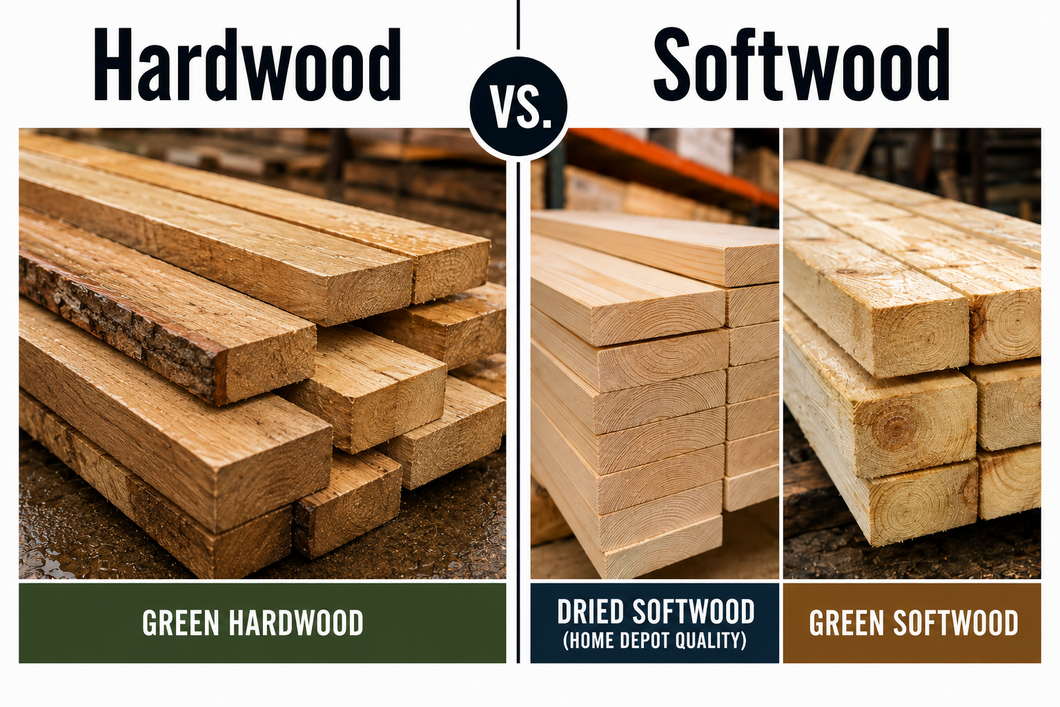
Hardwood pallets and softwood pallets can both be the right choice for Minnesota businesses. The better question is not simply which wood is stronger. The better question is which pallet design will protect your product, fit your equipment, stay available when you need it, and make sense for your budget.
At Gruber Pallets in Lake Elmo, our team has spent over 40 years helping manufacturers, distributors, food and beverage companies, warehouses, and contractors across Minneapolis, St. Paul, and the Twin Cities choose practical wood pallet options. Here is how to think through hardwood vs softwood before you request a quote.
What Is a Hardwood Pallet?
A hardwood pallet is built from lumber that comes from broadleaf trees. In pallet buying conversations, hardwood is often associated with strength, durability, and repeated handling. That reputation is useful, but it can also be oversimplified.
Hardwood does not automatically mean every pallet will hold more weight. Pallet performance depends on the full specification: board thickness, stringer or block design, fastener quality, deck board spacing, pallet size, load distribution, forklift handling, and whether the pallet will sit in racking.
Hardwood pallets often make sense when the pallet will be reused, handled frequently, carry heavier loads, or move through tough warehouse conditions. They can also be a good fit when consistency and durability matter more than the lowest possible initial cost.
What Is a Softwood Pallet?
A softwood pallet is built from lumber that comes from conifer trees, such as pine or similar species. Softwood pallets can be lighter and cost-effective, especially when the application does not require a heavy-duty reusable pallet.
Softwood should not be dismissed as weak. A properly designed softwood pallet can perform well for many shipping, storage, and one-way applications. The key is matching the lumber and construction to the actual load and handling environment.
Softwood pallets may be useful for lighter products, clean new-pallet applications, export packaging, or cost-sensitive shipments where the pallet is not expected to cycle repeatedly for years.
Hardwood vs Softwood: The Practical Difference
The practical difference is how the pallet behaves under your real operating conditions. If a pallet is going to carry heavy product, move through multiple warehouse touches, sit in racking, or return for reuse, durability becomes more important. If the pallet is going out one way with a moderate load, weight, cost, and availability may matter more.
Load weight and product risk
Heavier products usually need a stronger overall pallet design. That may point toward hardwood, thicker components, closer deck board spacing, extra stringers, or a fully custom build. For lighter products, a softwood or recycled option may be more than enough.
Handling equipment
Forklifts, pallet jacks, conveyors, and racking systems all change the right answer. If a pallet will be dragged, turned, racked, double-stacked, or handled from multiple sides, construction details matter as much as wood species. For entry-style decisions, see our guide to 2-way vs 4-way pallets.
Cost and availability
Pallet pricing is affected by lumber markets, quantity, grade, heat treatment, delivery, and how standard or custom the build is. If you are comparing options, start with our Minnesota pallet pricing guide, then ask for a quote based on your actual specs.
Cleanliness and appearance
New pallets, whether hardwood or softwood, are often preferred when appearance, cleanliness, or product presentation matters. For some food, beverage, packaging, and retail-adjacent applications, a clean new pallet can be worth the added cost over recycled alternatives.
When Hardwood Pallets Make Sense
Hardwood pallets may be the better fit when your operation needs durability, repeated handling, or stronger components. Common situations include heavier manufactured goods, warehouse reuse programs, products with higher damage risk, and applications where pallet failure would create expensive downtime.
Hardwood can also be a good choice when your team wants a longer service life from each pallet. If the pallet stays in your network, returns to your facility, or supports repeat customer shipments, the higher initial cost may be easier to justify.
When Softwood Pallets Make Sense
Softwood pallets may be the better fit when weight, cost, or availability is a priority and the load does not require a heavier-duty pallet. They can work well for one-way shipments, lighter products, export-ready packaging, and situations where a new pallet is needed but hardwood durability is not essential.
Softwood is also worth considering when the pallet can be engineered to the job. The right board thickness, fastener pattern, and deck layout can make a softwood pallet a practical choice for many Minnesota shipping operations.
Do Heat-Treated Pallets Need Hardwood?
No. Heat treatment is about compliance, not species. A pallet must meet ISPM-15 requirements when it is used for many international shipments, but both hardwood and softwood pallets can be heat treated when they go through the proper certified process.
If you ship internationally from Minnesota, start with our heat-treated pallets page. The wood species decision should come after you confirm the destination, shipment requirements, load weight, and pallet size.
How Minnesota Buyers Should Choose
The fastest way to choose between hardwood and softwood is to describe the job the pallet has to do. A supplier should ask about the product, weight, pallet dimensions, warehouse handling, delivery location, storage conditions, and whether the pallet is used once or reused.
For many Twin Cities businesses, the right answer is not simply hardwood or softwood. It might be a new wood pallet, a recycled pallet, a heat-treated export pallet, or a custom pallet built around the product and handling system.
If you already have a pallet that works, keep the specs handy. If your current pallet is failing, arriving late, costing too much, or causing product damage, bring those pain points into the conversation. That is where material choice, design, and supplier experience come together.
FAQ
Are hardwood pallets stronger than softwood pallets?
Hardwood pallets are often chosen for durability and repeated handling, but strength depends on the full pallet design: lumber thickness, fasteners, deck board layout, stringers, and load pattern. A well-built softwood pallet can outperform a poorly specified hardwood pallet.
Are softwood pallets cheaper than hardwood pallets?
Softwood pallets can be more cost-effective when lumber availability is strong and the load does not require a heavier-duty design. Final pricing depends on size, quantity, heat treatment, delivery, and whether the pallet is new, recycled, or custom-built.
Which pallet is better for a warehouse in Minnesota?
For many Minnesota warehouses, the best pallet is the one matched to the product weight, forklift or pallet jack handling, racking system, and delivery schedule. Hardwood can make sense for repeated use; softwood can work well for lighter or one-way shipping when designed correctly.
Can hardwood or softwood pallets be heat treated?
Yes. Heat treatment is a compliance process for wood packaging, not a wood species. Both hardwood and softwood pallets can be heat treated when they meet ISPM-15 requirements and are stamped by a certified provider.
How do I know which pallet material to quote?
Share your pallet size, product weight, shipping frequency, handling method, racking needs, destination, and whether the pallet must be heat treated. A pallet supplier can then recommend hardwood, softwood, recycled, or custom options based on the actual use case.
Get the Right Pallet Quote
Gruber Pallets supplies new, recycled, custom, heat-treated, and GMA-style pallets from Lake Elmo to businesses across Minneapolis, St. Paul and the Twin Cities, with delivery booked online within 50 miles and quoted by hand farther out. If you are weighing hardwood vs softwood pallets, we can help you quote the option that fits the load, not just the label.
Request a pallet quote or call (651) 436-1912 with your pallet size, quantity, product weight, and delivery needs.