
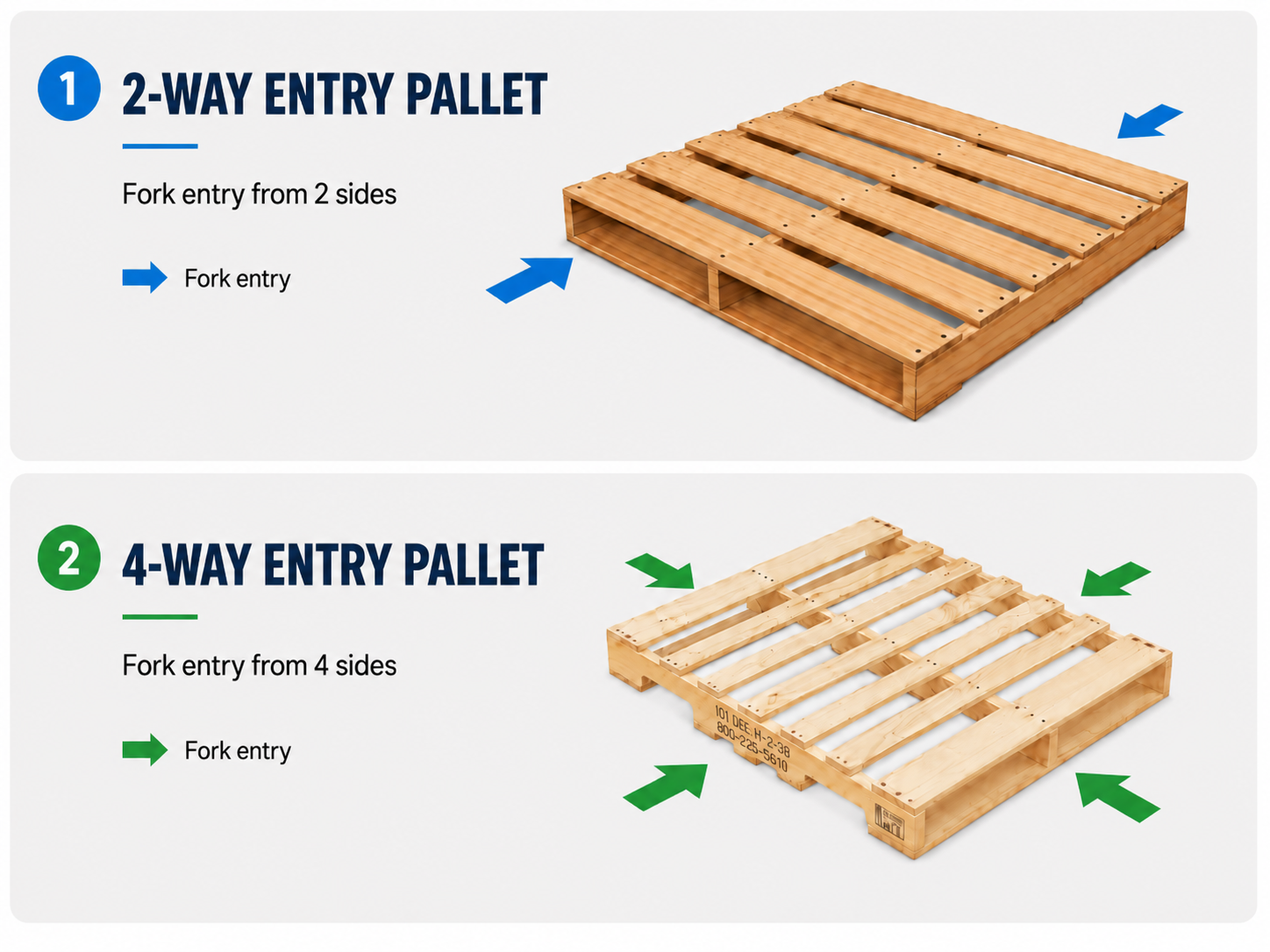
Choosing between 2-way vs 4-way pallets is not just a technical detail. For a Minnesota warehouse, manufacturer, food producer, distributor, or jobsite supplier, pallet entry affects how quickly loads move through the dock, how much room forklifts need, and whether a pallet creates avoidable handling problems after it leaves your building.
At Gruber Pallets in Lake Elmo, our team has over 40 years of industry experience helping Twin Cities businesses match pallet design to real freight, storage, and production needs. If you are ordering new wood pallets, comparing recycled pallets, or requesting a custom pallet, entry style is one of the first details worth getting right.
What 2-Way Pallet Entry Means
A 2-way pallet can be picked up from two opposite sides. In most wood pallet conversations, that means the forklift or pallet jack enters from the open ends of a stringer pallet. The long stringers support the deck boards and create two clear entry points.
This design is common because it is straightforward, strong, and often economical. For simple one-direction loading, predictable dock flow, and products that do not need frequent repositioning, a 2-way pallet can work well.
Where 2-way pallets fit best
Two-way pallets are often a good fit when loads move in a consistent direction, when pallets are staged with enough aisle space, or when the pallet only needs to be handled a few times before reaching its destination. They can also be useful for certain heavier loads because the stringer layout provides a direct support path.
The tradeoff is maneuverability. If the pallet is turned the wrong direction in a trailer, rack position, production cell, or crowded dock area, the operator may have to reposition the load before moving it safely.
What 4-Way Pallet Entry Means
A 4-way pallet can be entered from all four sides. That extra access may come from a block pallet design or from notched stringers that create side openings for forklift tines.
For busy Minneapolis-St. Paul operations, the biggest advantage is flexibility. A forklift operator can approach the pallet from more directions, which can reduce turning, backing, and wasted dock movement. That matters when pallets are being unloaded from trailers, staged in narrow aisles, transferred between departments, or handled by more than one facility.
True 4-way vs partial 4-way access
Not every 4-way pallet handles the same. A block pallet usually provides true 4-way access and is often friendlier to both forklifts and pallet jacks. A notched stringer pallet may allow side forklift entry, but pallet jack access can depend on notch height, bottom deck layout, and floor conditions.
That distinction is important if your team uses pallet jacks more often than forklifts. Before ordering, tell your supplier what equipment will actually move the pallets.
2-Way vs 4-Way Pallets: Key Differences
The main difference is entry access, but the decision affects several parts of the operation.
Handling speed: 4-way pallets are usually easier to grab quickly from different angles. That can help in tight docks, trailers, production areas, and high-volume warehouses.
Space use: 4-way access can make staging more forgiving because pallets do not always have to face one direction. Two-way pallets may require more planning so operators can reach the open ends.
Cost: 2-way pallets can be less expensive depending on lumber, size, grade, and construction. Four-way designs may cost more, especially when they require block construction or extra machining.
Strength and load path: The strongest option depends on the full pallet spec, not the entry label alone. Deck boards, stringers, blocks, fasteners, lumber species, moisture, and load distribution all matter. For weight planning, see our pallet weight limits guide.
Equipment fit: A forklift, walkie, pallet jack, automated conveyor, or racking system may prefer one design over another. If equipment compatibility is the reason for the change, share those details before the pallet is built.
When to Choose a 2-Way Pallet
A 2-way pallet may be the right choice when your team has a simple loading pattern and wants a practical, cost-conscious pallet. It can work well for one-way shipments, predictable production flow, and pallet loads that do not need to be turned or accessed from multiple sides.
It may also be the better choice when a specific stringer layout has already been tested with your load. Some buyers ask for 4-way access when the real issue is deck board spacing, pallet size, or load capacity. In that case, changing entry style alone may not fix the problem.
When to Choose a 4-Way Pallet
A 4-way pallet is often the better fit when speed and flexibility matter. If your team loads trailers from different angles, stages pallets in tight areas, uses multiple handling methods, or sends pallets through another companys warehouse, 4-way access can reduce friction.
Four-way pallets also make sense for many custom pallet projects. If your product is oversized, awkward, heavy, or handled in more than one direction, adding 4-way access during the design stage can be easier than trying to work around a handling problem later.
How Minnesota Buyers Should Decide
Before ordering, ask a few practical questions:
- Will the pallet be moved by forklift, pallet jack, conveyor, or a mix of equipment?
- Does your dock or warehouse have enough room to approach from only two sides?
- Will another facility handle the pallet after it leaves Minnesota?
- Is this a one-way shipment, a reusable pallet, or part of a recurring pallet program?
- Do you need a standard 48x40 pallet, a custom footprint, or heat-treated export compliance?
If you are unsure, Gruber Pallets can review your product size, load weight, equipment, delivery location, and handling requirements before recommending a design. For size and capacity basics, start with our pallet dimensions guide.
Common Mistakes to Avoid
The first mistake is assuming 4-way always means better. It is better only when the added access solves a real handling problem or creates enough efficiency to justify the spec.
The second mistake is comparing only unit price. A pallet that saves a few dollars but slows unloading, causes product damage, or creates repeated forklift handling can be more expensive in practice.
The third mistake is using a generic spec without telling your supplier how the pallet will be handled. A good pallet quote should include size, quantity, condition, heat-treatment needs, load weight, delivery area, and equipment requirements.
Get the Right Pallet Spec
Gruber Pallets supplies new, recycled, custom, and heat-treated pallets for businesses across Minneapolis, St. Paul and the Twin Cities, with delivery booked online within 50 miles of Lake Elmo and quoted by hand farther out. Whether you need a simple 2-way pallet, a 4-way custom build, or help comparing options, our team can help you choose the design that fits the job.
Request a pallet quote and include your preferred pallet size, monthly volume, load weight, handling equipment, delivery location, and whether you need 2-way or 4-way access.
FAQ
What is the difference between a 2-way and 4-way pallet?
A 2-way pallet can be entered from two opposite sides. A 4-way pallet can be entered from all four sides, either through block construction or notched stringers.
Are 4-way pallets better than 2-way pallets?
Not always. 4-way pallets are easier to move in tight warehouses and trailers, while 2-way pallets can be a practical choice when cost, simple handling, or a specific load path matters more.
Can a pallet jack use a 4-way pallet from every side?
It depends on the pallet design. Many true block pallets support pallet-jack access from all four sides, while some notched stringer pallets provide forklift access from the side but may be less friendly for pallet jacks.
Do 4-way pallets cost more?
They can cost more when they require extra notching, block construction, or tighter specifications. The right choice should compare total handling efficiency, damage reduction, and delivery flow, not only unit price.
Which pallet should Minnesota businesses order?
Most Twin Cities buyers should choose based on forklift access, dock layout, trailer loading, product weight, and whether the pallet will be reused, stored, shipped one way, or handled by multiple facilities.