
Free video series · 6 lessons · 20 minutes
Become An Expert
“ If knowledge is power, then knowledge of pallets is pallet power. This world would be a much more peaceful place if part of the people in power were prescribed with more pallet knowledge. ”
Six short videos from the Gruber Pallets team that condense the whole pallet industry into a lunch break. Start with lesson 1 or jump to the one you need.
The classroom
Watch the series
Pick any lesson. The player switches without leaving the page and we remember which ones you have finished.
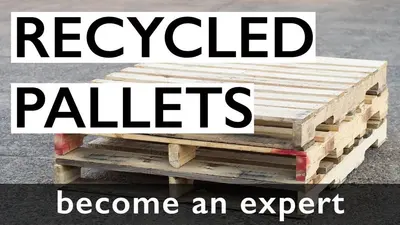
Recycled Pallets
What a recycled pallet is, how it is graded, and when it is the smart buy.
What you will learn
- Holds 1,500 to 3,000 lb depending on how the load is spread
- Graded #1 and #2 (or A and B) by size, stringers and repairs
- Drier than new lumber, so less mold risk
- Costs about 40 to 60% of a new pallet



Prefer to read?
Lesson notes
The same six lessons as a written outline. Open a row to read it. Each one takes about a minute to skim.
01Recycled Pallets3:42
In this video, we discuss the characteristics, advantages, and disadvantages of using a recycled pallet. If you would like to learn more, visit our website at www.gruberpallets.com.
Definition
A recycled pallet is any pallet that has been used before, and it may have repaired stringers or deckboards. In fact, the majority of the pallets in circulation have been reused or repaired. Here are some characteristics, advantages, and disadvantages of using a recycled pallet compared with using brand new.
Characteristics
Capacity Recycled pallets can hold anywhere between 1500 and 3000 pounds which is largely influenced by the way the product is distributed on the pallet. Pallets will hold more weight if the item is evenly placed, whereas pallets with concentrated loads in one particular area will not be nearly as sturdy.
Classifications Most companies will sort recycled pallets out using few key identifiers 1) dimension, 2) number of stringers, and 3) amount of repairs on the stringer - some companies will even sort pallets based on whether they are heavy-duty or light-duty. It is standard in the industry to use terminology of "#1 Grade, #2 Grade" while some refer to their pallets as "A Grade, and B Grade."
Advantages
Reduced moisture By virtue of a longer lifespan, recycled pallets have more time to dry and typically register 15% moisture content or less, while a new, "green" pallet can carry 25% or more moisture content. Dry pallets limit the opportunity for moisture to move from the pallet through the paper or cardboard packaging surrounding the product that needs to be shipped which could damage the packaging and also damage the product. Secondly, dry pallets are not as easily susceptible to mold. Moisture is one of the primary ingredients for mold growth, and so a dry pallet is at relatively low risk for attracting a mold spore and housing its growth.
Pricing Recycled pallets are significantly more cost effective than brand new pallets. Based on national averages, recycled pallets tend to cost about 40 – 60% the price of their new pallet counterparts.
Disadvantages
Inconsistent quality Because recycled pallets are collected from various locations, there is always the possibility of inconsistent quality in deckboard spacing, stringer or deckboard thickness, or nails or staples that are not perfectly flush with the deckboards that they are nailed into. Another disadvantage to recycled pallets is the difficulty tracing exactly where each pallet has been. There is no pallet recycler that than absolutely guarantee where each pallet has been on each step of its illustrious pallet career. While many companies might not need to know this kind of information, a clean history is typically a concern for companies in heavily-regulated industries that deal with products like infant formula, powdered food ingredients, etc.
Limited supply Recycled pallets also undergo a cycle of short supply. Because a pallet recycler can only sell pallets they have picked up and repaired, recycled pallets are limited by the number of pallets available on the market. About every 3-5 years, the pallet industry undergoes an ebb and flow of having more pallets available than there is demand, and then not enough pallets to go around.
Summary
A recycled pallet will hold a couple thousand pounds, they will stay dry, you will not know exactly where it has been, but recycled pallets do a great job of taking a simple product and transporting it from Point A to Point B.
02New Pallets3:44
Definition
New wood pallets refer to a pallet that has been put together with any grade of new wood material. There are all kinds of options: Dry, wet, high-density, low-density, bark, no bark, any many different types of species, but we will save that for another time. In this video, we will take a look at some common characteristics, along with some advantages and disadvantages of using a new pallet.
Characteristics
Most new 48 x 40 pallets are made to the GMA specification and can hold anywhere from 2000 – 3000lbs of evenly placed product. Some companies manufacture by hand, and some build on a machine, but there is not a significant difference in pallet quality between hand-built and machine-built pallets. Now keep in mind that although the process to build new pallets is fairly simple, not all pallet companies orient their business around new pallets. Some focus mostly on recycling, while others have streamlined their process and pricing for building new.
Common Industries
Here are a few industries that often particularly benefit from using a new pallet:
Infant formula
Powdered / granulated food ingredients
Raw food ingredients
Medical devices
Club distribution
Electronics manufacturing
Advantages
Sanitary: Brand new pallets are assembled from never before used, clean, virgin lumber. This provides a peace of mind to whoever puts finished product on it that there is no way that it will have any quality problems. Pallets that have been recycled or built from recycled material may have been exposed to the weather, they may have been stored outside, and they may have transported a contaminated product on it. New pallets overcome all of those problems.
Trackable: Each pallet company knows the mill where new lumber was cut and approximately how long ago it was taken from the log. Companies that use new pallets don't need to ask the question about the safety of the pallet's origin because it has never been used before.
Consistent: A new pallet will be built to the same specification every single time, no matter whether it is built by machine or by hand. If a group of pallets are hand built, there may be small variations in where exactly the nails are placed in each board, but those variances typically do not present a meaningful difference.
Aesthetics: The fact of the matter is that new pallets just look great. They look amazing. They are fresh, they are clean looking, and they can even make a product look even better simply by the strikingly beautiful pallet presentation.
Disadvantages
Moisture: Certain grades of new lumber have higher moisture content than others, and those specific grades can present issues when stored in enclosed areas with little ventilation. One example of this environment would be a warehouse or trailer with no moving air. This is not the case with all new grades of lumber but it is worth considering when deciding which type of pallet is best for the particular application.
Price: New pallets have a number of wonderful and amazing features, but they can be expensive. Based on national averages, a new pallet costs anywhere from 40 – 60% more than a similarly built recycled pallet.
Summary
New pallets are durable, trackable, traceable, clean, and more consistent than recycled pallets although they cost more up-front to purchase. They do their best work for applications that demand a sanitary shipping device or simply just a good looking pallet.
03New Pallets, Advanced3:31
We tackle the distinctions in hardwood vs softwood, #1 vs #2 grade lumber, and green vs kiln dried lumber. For more information about pallets, visit our website at www.gruberpallets.com.
We build upon what we discussed in our first New Pallet video and get in to some more specifics regarding the differences between hardwood vs softwood, #1 vs #2 grade lumber, and green vs kiln dried. If you have not yet seen our first video, we recommend taking a look at it for some context. But far be it from us to tell you what to do. Let's get to it.
Hardwood / softwood
Hardwood trees are angiosperms, which simply means that their seeds are protected by a shell. A couple examples of a seed inside of a shell is the acorn which comes from an oak tree and the walnut which, you guessed it, comes from a walnut tree. You can usually tell a hardwood tree by it's 1) shell encased seed, 2) broad leaves, or 3) its densely packed wood grain. A standard size lumber cut for hardwood pallets is between 9/16 – 5/8" for the deckboards and between 1 1/8" - 1 and 1 3/8" stringers.
Softwood trees are gymnosperms, which literally means "naked seeds." An example of this would be the pine or spruce nuts that you find by shaking out a pine or spruce cone. You can usually tell a softwood by 1) the cones that develop on the tree, 2) its spindly needly leaves, or 3) its loosely packed wood grain that easily dents and scratches. A standard lumber cut for softwood pallets is anywhere between 11/16" and ¾" for the deckboards, and 1 1/4" and 1 ½" for the stringers
#1 vs #2
The defining characteristic between #1 and #2 grade lumber is the amount of bark or wane left on the piece after it has been cut from the log. #1 grade wood is bark free and each piece is able to pass inspection for ISPM-15 Heat Treat compliance. #2 grade lumber has either too much wane to hold the same weight as a #1 grade board or has too much bark and is therefore not able to be heat treated and is too brittle to hold the same load as #1 grade. Each sawmill determines the point at which a piece can pass as a board and when it is too compromised to be safely used on a pallet. Companies that keep more pieces sell their wood cheaper while companies that adhere to a stricter quality standard are more costly.
Green vs Kiln Dried
Standard softwood pallets tend to be kiln dried while hardwood pallets are almost never kiln dried. The reason for this is that softwood lumber is more porous and therefore able to dry much more quickly than densely fibered hardwood. Softwood also benefits more from being kiln dried because it molds much more quickly than hardwood. Although both are susceptible to mold, kiln dried has an edge on green hardwood because it has been dried to lower than 15% moisture content while green hardwood can be between 20 – 40% moisture content.
Pricing
Pricing for softwood vs. Hardwood is funny. Although each region will have different average prices, the general principle is the same. At the bottom of the bottom you have #2 grade green soft and hardwood, they are basically the same, then you have #1 grade green softwood, #1 grade wet hardwood, then dry softwood above that. When you get into heat treating for export, it can be a toss up between which is more cost-effective, hardwood or dried softwood. Some companies have streamlined their hardwood process and some focus on softwood. Check with your local companies on how exactly it goes, it will vary depending on how each manufacturer has oriented their operation.
Which type of lumber is best?
If you are considering using new pallets and need to figure out which type of lumber would best fit you, call your local pallet company and they should be able to help you. Keep in mind that some pallet companies are oriented towards pallet recycling and while other companies are oriented towards new pallets and might have more resources for you.
04Heat Treating for Export3:53
The heat treating process for pallets, crates, or wood pieces is intended to kill any living organism in the material before export. We will discuss when a pallet should be heat treated, how a pallet should be heat treated, what heat treat stamp marks mean, and some cautions to keep in mind when considering heat treating for export.
Definitions
IPPC: The International Plant Protection Convention is a resolution created by the Food and Agriculture Organization with the intended aim to establish global standards for plant health. The part of this resolution that pertains to pallets is referred to as ISPM-15.
ISPM-15: This is the set of regulations that specifically refer to the standards that govern wood greater than 6millimeters that needs to be heat treated when shipping products to different countries
What can be heat treated?
Any kind of wood can be heat treated: new, recycled, reused, repaired, single pieces, bundles – all can be treated, but all must be stamped with the corresponding stamp.
Why do you need heat treated pallets?
The goal of heat treating is to kill bugs and any living organisms so that they won't be given a free international cruise or flight, bringing their sicknesses and diseases with them. Heat treating does not increase the strength or durability of the pallet, it only protects it from bugs.
Exemptions
Anything 6mm or less
Any wood that has been processed in a way that kills pests, like a cigar or wine box
Any type of wood that uses glue, veneer, or processed strand board
Previously heat treated pallet that has not been repaired, remanufactured, or altered in any way with a valid certification stamp
Corrugate, plastic, other non wood items
Process
Both new pallets and recycled pallets need to be appropriately debarked. Small isolated pieces of bark are allowed if they are less than 3cm wide or with total surface area less than 50mm, which is about the size of a credit card.
After a pallet, crate, or dunnage piece has been appropriately debarked, it then enters the heat treater to be heated to 56 Celsius 132.8 Farenheit for 30 minutes. Then and only then can the heat treat stamp be applied.
If no structural changes are made to the pallet, the pallet should be able to retain their heat treat status indefinitely.
Stamp elements
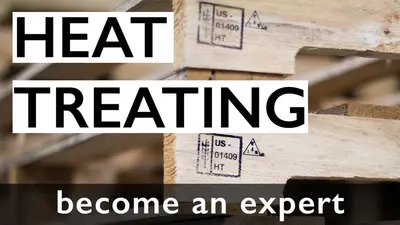
Wheat stamp: This signifies compliance with the IPPC, and will appear to the left of the rest of the information
Country of origin: The country code is always 2 letters
Producer / treatment provider: this is a combination of digits and or letters that uniquely identify the producer
Treatment Code: This is either an "HT" or "MB" marking on the material signifying whether or not the it was heat treated or methyl bromide treated
Agency: In the US, the inspection agency is also included in the stamp information
For each stamp to be compliant for export, It must be: Durable, Legible, Visible when in use with no aids, and stamped with black ink, because red or orange are often used to signify a harmful product type
If the mark does not meet all of these criteria, the packaging item may be subject to confiscation by export authorities.
Alternative methods for export
Fumigation Fumigation using methyl bromide is the only other way to export wood without changing the composition of the pallet. With fumigation, the pallet is confined in a gas chamber for anywhere from 4-24 hours to soak in all of the gaseous methyl bromide.
The other way to export is to use a substance that made or processed in a way that eliminates the opportunity for life growth in the pallet. Some examples of this would be plastic, plywood, particle board, OSB, strand board, corrugate, to name a few.
Cautions
Some pallet companies have been caught with expired or suspended heat treating licenses, so if you have any questions or suspicions about a particular company and their heat treating process, be sure to get a copy of the company's heat treat certificate issued by their inspection agency. That way, the agency can confirm or deny the validity of the questionable heat treating process. If a company is hesitant or slow to release their certification, something may be going awry.
You might find some pieces that have the letters "HT" stamped on them, but if they do not have the complete mark like we mentioned before, they are not legally exportable in their current state.
Summary
When looking to export a product, heat treating is a great way to go. There are regulations to what is allowed to be heat treated, and be sure your packaging company is following the rules that are in place. Once that homework is finished with the documentation in place, happy exporting!
05Getting Rid of Pallets2:47
In this video we take a look at the value of different types of pallets and we give you a few ideas about how to get rid of pallets that you don't need or can't use without spending a whole lot. Heck, maybe you can even make a few dollars. To find out more, visit www.gruberpallets.com
QUANTITIES
A few things to keep in mind in this discussion is that small quantities of pallets are not worth as much as large quantities. To most established pallet companies, a small quantity is anywhere below 200 pallets, and a full load is around 400. It is important to mention that neatly stacked and organized pallets or wood waste is more valuable than wood that is haphazardly collected.
VALUE OF DIFFERENT PALLET TYPES
48 x 40 pallets
48 x 40's, cores, 4ways, GMAs, 1's and 2's, A's and B's all refer to the industry standard pallet that most companies use for all kinds of applications. If you have pallets like this, chances are good that somebody can pay for them. They are the most valuable because they are easy to fix and there is a high demand in the market for pallets this size that have been repaired and resold.
Odd sized
48 x 48, 48 x 42, and 42 x 42 are a few odd sizes that a pallet company may also save and repair for resale. Some companies save pallets like this, and some do not, but if they do they might also be able to compensate for those sizes.
Very Odd sizes
Pallets come in all shapes and sizes and some industries collect an assortment of pallets that do not fit any of these common pallets. A pallet might be 72 x 50 or 40 x 51 or 52 x 24 or have a strange block in the middle of it, there really are infinite options. At full truckload volumes, a pallet company might pay a small price for them but most likely they will pick up for free or a small disposal fee.
Broken beyond repair / wood waste
Plywood pallets, particle board pallets, crates, bundles of loose wood, and pallets needing numerous repairs are a few examples of wood waste that most companies will charge a disposal fee to pick up and process. If no pallet company will pick up the wood waste at no charge, there may still be companies that are dedicated to grinding boiler fuel and bark mulch that may recycle the material at no charge.
WHO TO CALL
Pallet companies
If you have 48 x 40 or odd sized pallets, call a local pallet recycler, and depending on volume they may be able to pay for them. Pallet companies prefer a dock and a forklift to load pallets on their trailer. If no dock is available, a forklift and pallet jack are necessary to load the pallets and bring them to the nose of the trailer. Some pallet companies use flatbed trailers, and these are easier to load, but they are less common and not all companies use them.
Wood waste processing companies
If you have inconsistent sized pallets along with crates and other non pallet items, a pallet company may help but you will have more luck calling a company that produces boiler fuel or wood chips because they tend to be less picky with the wood waste that they recycle. Garbage disposal companies have also been known to leave a dumpster on site at low cost if they can guarantee that only wood waste is being thrown in it.
Craigslist
You would be surprised, good ol' buddy ol' Craig over at Craigslist seems like he is always looking for pallets, even in small volumes. There are pallet scavengers everywhere scouring for free pallets and if you advertise what you have as free, you might get some bites on that line.
Bonfires: pallets burn real nice. If you can't find a company, recycler, or a pallet scavenger to bite on your pallets without charge, bring them home or out to a field to burn.
SUMMARY
If you need to get rid of pallets, do your best to save as many as you can, stack them neatly, and load them neatly – that will ensure you to get the best financial outcome for disposing your pallets. There are common sizes, uncommon sizes, and wood waste – they each have optimal outlets for disposal. When it comes to pallet recycling, knowledge is power. Be sure to make as many calls as you can to be sure you are doing the best for yourself and your company.
06Pallet Disposal1:53
We discuss the life of a pallet after it has been deemed unrepairable or unsalvageable. If you would like to learn more, visit our website at www.gruberpallets.com.
Pallet Disposal
Have you ever wondered what happens to wood waste and pallets that are completely unusable? Do they get thrown away, burned, ground up, or something else?
Step 1 Each pallet that comes into a pallet company gets sorted out as either repairable or non-repairable. If it is repairable, it will be fixed and staged to be re-sold. If it is not repairable, it will be designated to the grinder.
Step 2 The pallets are put in a staging area which can be either a mound or a neat stack and then they are loaded into the grinder. The conveyor brings the pallets to the throat of the machine where the pallets are chewed up and ground into either animal bedding, bark mulch, boiler fuel, or some other byproduct.
Now what about the nails? How does a pallet company avoid grinding nails and sending them to a horse farm or putting them in with bark mulch? You sure do ask great questions. The magnet at the end of the conveyor that throws the mulch into the trailer can pull nails through over 3 inches of wood and as soon as the conveyor gets to the top and comes back around the bottom side it releases the nails into a tray that feeds into a dumpster of some kind that contains them.
Step 3 With a full trailer of product, the pallet company is ready to start the whole process again.
Now not every company grinds for mulch and animal bedding, some grind for wood pellets, and some grind to fuel incinerators. Every company has their own niche but rarely are pallet companies in the grinding business to make a whole lot of money. Remember, grinding pallets is an alternative to throwing them away and there is not much money to be made on this side of the business but it is one more a company can continue to recycle and stay happy, healthy, and environmentally friendly.
Class dismissed
Now you know pallets. Put it to work.
Lessons 1, 2 and 4
Buy pallets online
New, recycled or heat treated. Pick a size and check out in a few minutes. Free pickup in Lake Elmo, delivery priced by distance.
Buy Pallets Online →Lesson 3
Get a quote
Custom sizes, hardwood or softwood, kiln dried, 500 pallets or more. Tell us the spec and we price it.
Get Quote →Lessons 5 and 6
Sell us your pallets
We pay for 48 × 40 cores and haul away the rest. Four taps gets you a pickup offer.
Get a pickup offer →