
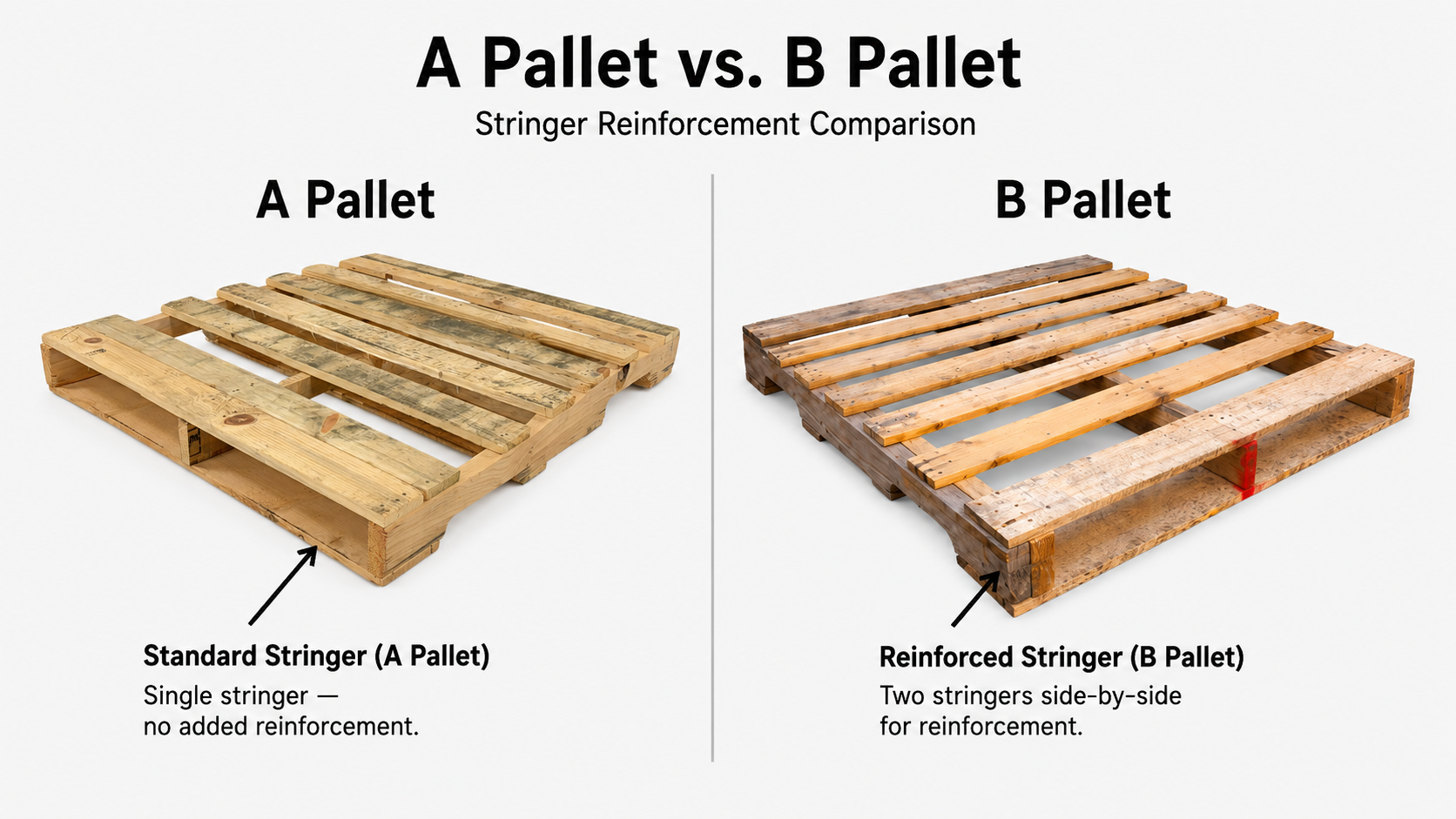
Pallet grades give Minnesota buyers a practical way to compare used and recycled pallets before placing an order. If you have ever been quoted Grade A pallets, Grade B pallets, reconditioned pallets, or recycled pallets and wondered what the difference means, the answer is mostly about condition, repair history, appearance, and fit for the job.
At Gruber Pallets, our team has over 40 years of industry experience helping Twin Cities businesses choose pallets that match their product, warehouse equipment, delivery schedule, and budget. A lower-cost pallet is only a good deal when it performs safely in your operation. A premium pallet is only worth the extra cost when your load, customer, or process actually needs it.
What Pallet Grades Mean
Pallet grades are shorthand for the condition of recycled wood pallets. They are most often used for standard 48x40 GMA-style pallets, but the same thinking can apply to other common recycled pallet sizes. Grade A pallets are usually synonymous with #1 grade pallets, or "number ones." Grade B pallets are usually synonymous with #2 grade pallets, or "number twos." A grade does not replace a real inspection, and grading language can vary from supplier to supplier, but it gives buyers a useful starting point.
That loose language matters. There is no single universal grading standard that every pallet company applies the same way. What one supplier calls Grade A may not be identical to another supplier's Grade A. The grade name should be treated as a practical buying shorthand, not a guarantee by itself. The real question is how the pallet was inspected, what repairs are present, and whether the pallet fits the load and handling environment.
In general, higher grades have cleaner boards, more consistent appearance, fewer repairs, and less visible wear. Lower grades may still be structurally useful, but they usually show more prior handling, repaired components, mixed board color, or cosmetic variation. For many B2B shipments, the right answer is not always the prettiest pallet. It is the pallet that carries the load, moves cleanly through your handling system, and makes financial sense.
Grade A Pallets
Grade A pallets, also commonly called #1 pallets or number ones, are usually the higher-condition option in the recycled pallet category. They are often used when a business wants a cleaner, more uniform pallet without paying for a brand-new pallet. One of the practical differences is in the runners or stringers: on a true higher-grade recycled pallet, the runners are typically original/virgin pieces with no cracks and no added repair plugs alongside them. A Grade A pallet may be a good fit for customer-facing shipments, retail distribution, food-adjacent environments, clean warehouse programs, or operations where consistent appearance helps avoid downstream questions.
Common Grade A traits
- Cleaner and more uniform appearance than lower-grade recycled pallets
- Minimal visible wear compared with heavily used pallets
- Fewer major repairs, depending on the supplier's grading rules
- Runners/stringers are typically original pieces without cracks or added repair plugs
- More consistent board quality and overall presentation
- Often a stronger fit for outbound shipments where the customer sees the pallet
Grade A does not automatically mean new. It also does not mean the pallet is right for every export, food, racking, or heavy-load application. If the shipment requires a new pallet, heat treatment, a custom footprint, or a specific load rating, it is better to ask directly than to rely on grade language alone.
Grade B Pallets
Grade B pallets, also commonly called #2 pallets or number twos, are usually the value option for businesses that need functional recycled pallets at a lower cost. They may have more visible wear, patched areas, repaired stringers, companion boards, or mixed lumber appearance. A common difference is stringer repair: Grade B pallets often have a plug, companion stringer, partial runner, or smaller repair piece added alongside a cracked or damaged runner to restore function. For many internal moves, warehouse transfers, manufacturing shipments, and one-way loads, a properly inspected Grade B pallet can be a smart choice.
Common Grade B traits
- More visible wear than Grade A pallets
- Repairs may be present, including reinforced stringers, plugs, partial runners, or companion-board areas
- Appearance can vary more from pallet to pallet
- Often priced below Grade A recycled pallets
- Best suited for practical shipping needs where appearance is less important
The key word is inspected. A good Grade B pallet should still be usable for the intended load and handling environment. A pallet with loose boards, severe splitting, missing structural components, or unsafe damage should not be treated as an acceptable Grade B just because it is cheaper.
Grade A vs Grade B: How to Choose
Start with the job the pallet has to do. If the pallet will leave your facility and represent your product to a customer, Grade A may be worth the premium. If the pallet is moving goods inside a plant, going to a familiar receiving dock, or supporting a cost-sensitive shipment, Grade B may be enough.
Businesses in Minneapolis, St. Paul, and the wider Twin Cities also need to think about delivery rhythm. If you order pallets weekly or monthly, consistency matters. A supplier should be able to help you set expectations for the grade, quantity, condition range, and backup options if supply changes.
Choose Grade A when
- Customer presentation matters
- Loads are going into cleaner environments
- You want fewer cosmetic objections from receivers
- You need a more uniform recycled option
- Your pallet program values consistency over lowest upfront cost
Choose Grade B when
- Budget is a major factor
- Appearance is less important than function
- The pallet is used for internal handling or one-way shipping
- The load is not unusually heavy or fragile
- You have a supplier who inspects and sorts pallets carefully
When Recycled Grades Are Not Enough
Sometimes the right answer is neither Grade A nor Grade B. If your load is oversized, unusually heavy, automated, export-bound, or sensitive to contamination concerns, a different pallet may be safer and more reliable.
For export shipments, review heat-treated pallet requirements. For a non-standard footprint or equipment-specific design, see custom pallets in Minnesota. If you are comparing used pallet options, start with recycled wood pallets or the used and refurbished pallets page.
Local Buying Tips for Minnesota Businesses
When comparing pallet grades, ask your supplier five questions before buying:
- What does Grade A or Grade B mean in your sorting process?
- Are repaired stringers allowed in this grade?
- Are these pallets inspected before delivery?
- What load or handling conditions should I tell you about?
- Can you keep the same grade available on a recurring schedule?
These questions help prevent the common problem of buying only on price and discovering later that the pallet does not fit the process. For many Minnesota manufacturers, warehouses, distributors, food processors, and logistics teams, the best pallet program is a mix: new pallets where precision matters, recycled Grade A where presentation matters, and Grade B where cost control matters.
FAQ: Pallet Grades
What do pallet grades mean?
Pallet grades describe the condition and repair history of used or recycled pallets. Grade A is commonly called #1 or number one, and Grade B is commonly called #2 or number two. These labels help buyers compare cleanliness, appearance, structural consistency, and expected price, but they are industry shorthand and can vary by supplier.
What is a Grade A pallet?
A Grade A pallet, or #1 pallet, is typically a cleaner, higher-condition recycled pallet with little wear and no major runner/stringer repair. The runners are usually original pieces with no cracks and no added repair plugs. It is often chosen when appearance and consistency matter.
What is a Grade B pallet?
A Grade B pallet, or #2 pallet, is a structurally usable recycled pallet that may show more wear or have repairs such as companion boards, repaired stringers, plugs, partial runners, or smaller pieces added alongside damaged runners. It is often the value choice for internal shipping and warehouse use.
Are Grade B pallets safe to use?
Grade B pallets can be safe when they are properly inspected, repaired, and matched to the load and handling environment. Buyers should avoid badly damaged pallets and confirm capacity needs with the supplier.
Which pallet grade is best for food or retail shipments?
Food, retail, and display-sensitive shipments often need cleaner Grade A pallets or new pallets. The right choice depends on cleanliness expectations, load requirements, and whether the pallet will be seen by customers.
Can Gruber Pallets help choose the right grade?
Yes. Gruber Pallets can help Minnesota businesses compare new, recycled, reconditioned, and custom pallet options based on product weight, equipment, budget, delivery needs, and reuse plans.
Get the Right Pallet Grade
If you are deciding between Grade A pallets, Grade B pallets, new pallets, or reconditioned pallets, Gruber Pallets can help you match the pallet to the real job. Request a quote through our quote form or call (651) 436-1912 to talk through your pallet needs in the Minneapolis-St. Paul area.