
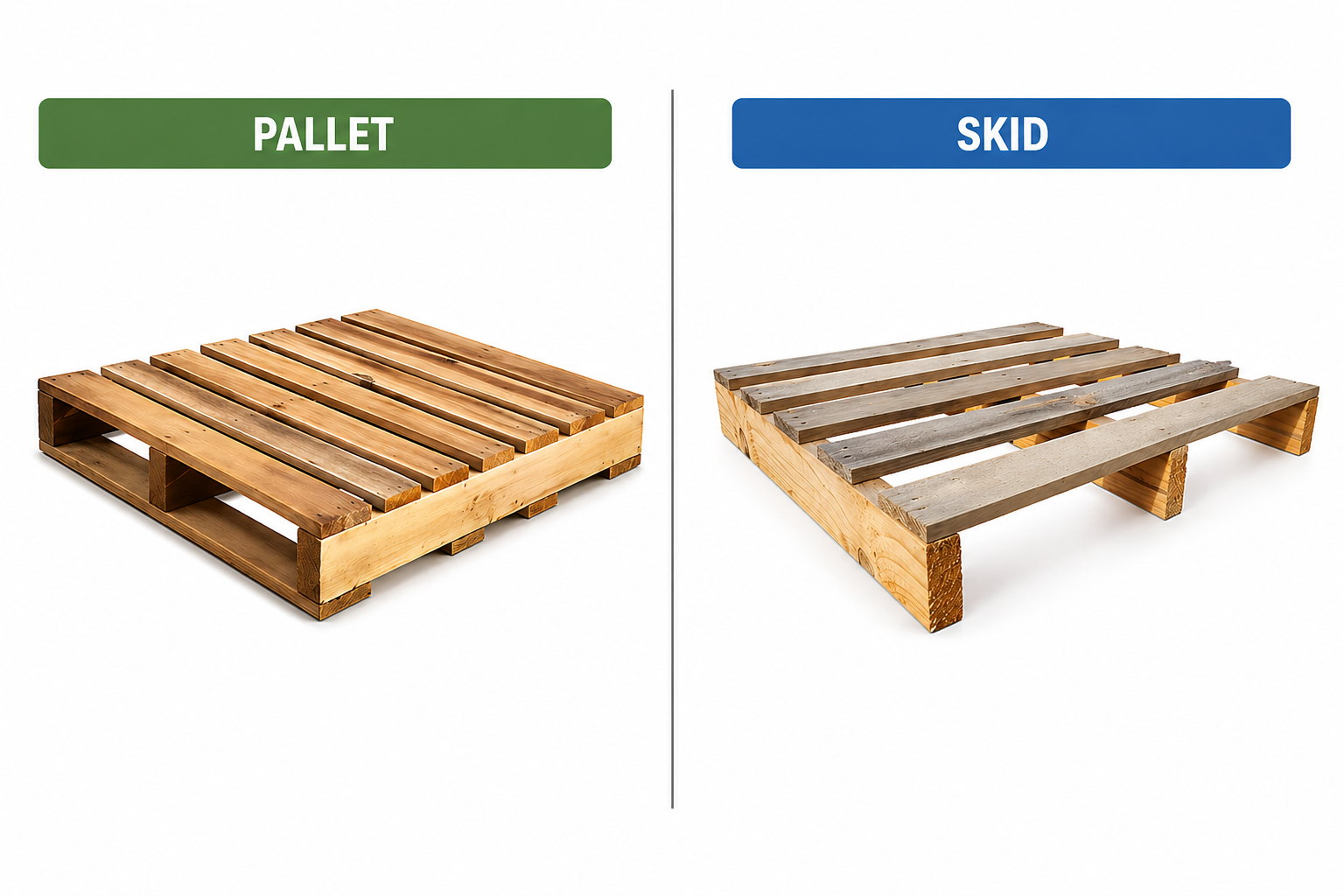
Pallet vs skid is a small wording difference that causes a lot of confusion for buyers. In practice, they are not the same thing, and choosing the wrong one can affect forklift handling, warehouse flow, load stability, and even whether your shipment arrives without damage. If your business in Minneapolis, St. Paul, or anywhere in Minnesota is trying to decide what platform to use, the right answer depends on how the load moves, where it is stored, and how often it needs to be handled.
At Gruber Pallets, we have spent over 40 years helping Minnesota businesses choose the right pallet solution for the job. Here is the simple breakdown.
What is the difference between a pallet and a skid?
The clearest difference is underneath the load.
A pallet has top and bottom deckboards
A wood pallet has boards on the top and the bottom, with stringers or blocks creating the structure in between. That bottom deck gives the load a more stable base, improves support during forklift handling, and makes pallets a better fit for racking, stacking, and warehouse movement.
A skid does not have bottom deckboards
A skid is more like a single-deck platform that sits on runners or stringers. Because there is no bottom deck, a skid is often better suited for machinery, static loads, or applications where the load mostly stays in one place or gets dragged into position rather than moved repeatedly through a warehouse.
When a pallet is the better choice
For most commercial shipping and storage applications, a pallet is the safer and more versatile option.
Better for forklifts, pallet jacks, and racking
If your team is moving product in and out of trailers, through production, or into warehouse racking, pallets usually make more sense. The bottom deck helps support the load, improves stability, and works better in standard material handling systems. That is one reason the 48x40 GMA pallet remains the standard across so many industries.
Better for stacked or repeat-use shipments
Pallets are usually the right fit when your load will be stacked, stored, or handled multiple times before it reaches the customer. Manufacturers, distributors, and food companies in the Twin Cities typically choose pallets because they are easier to move consistently and more predictable under repeated handling.
If you need a standard shipping platform, start with our new wood pallets, recycled pallets, or new vs. recycled guide.
When a skid makes more sense
Skids still have a place. They are just more specialized.
Better for machinery or stationary loads
Skids are often used under heavy equipment, industrial machinery, or loads that function more like a base than a shipping platform. If the load is going to sit in place, be dragged into position, or serve as a permanent support, a skid can be the better answer.
Better when simplicity matters more than warehouse compatibility
Because a skid has a simpler structure, it can work well in niche applications where you do not need the same level of forklift convenience, stacking support, or rack compatibility. That said, most businesses searching for a skid actually need a pallet once the full use case is clear.
How to decide which one your business needs
The easiest way to choose is to answer three questions.
How often will the load be moved?
If the load is handled repeatedly by forklift or pallet jack, a pallet is usually the better fit. If it mostly stays put, a skid may work.
Will the load be stored in racking or stacked?
If yes, lean toward a pallet. The bottom deck and overall structure make it better suited for warehouse storage and repeated stacking. If you are comparing capacities, our pallet weight limits guide is a good next read.
Is this a custom application?
If the load is oversized, oddly shaped, or tied to a piece of equipment, the answer may be a custom skid or custom pallet. Gruber Pallets builds custom pallet solutions for Minnesota businesses that need more than a standard footprint.
Pallet vs skid for Minnesota buyers
Most businesses in Minneapolis, St. Paul, and the broader Twin Cities do not need a technical definition. They need the right platform to move product safely and efficiently. In most day-to-day operations, that means pallets, not skids. But if you are shipping machinery, supporting a fixed load, or working through a specialized design, a skid may be the better option.
The important part is not the label. It is matching the design to the use case, the handling method, and the load itself.
Why Gruber Pallets is a practical resource for this decision
- Over 40 years of pallet experience serving Minnesota businesses
- Local support from Lake Elmo for Minneapolis, St. Paul, and surrounding markets
- Standard and custom solutions for shipping, warehousing, and specialty loads
- Straight answers when a pallet is the right fit and when a skid is better
If you are not sure which one your operation needs, we can help you sort that out quickly. Request a quote or call (651) 436-1912 and tell us what you are moving, how it is handled, and where it is going.
Frequently asked questions
What is the main difference between a pallet and a skid?
A pallet has top and bottom deckboards. A skid does not have bottom deckboards. That makes pallets better for forklift handling, racking, and repeat warehouse movement, while skids are often better for machinery or stationary loads.
Are skids cheaper than pallets?
Sometimes, but not always. A skid can use less material, but the right choice depends on the application. If a skid causes handling problems or load instability, the lower upfront cost is not worth it.
Do most businesses need pallets or skids?
Most businesses need pallets. For standard shipping, warehousing, and distribution, pallets are usually the better choice because they handle more efficiently with forklifts and pallet jacks.
When should I use a skid instead of a pallet?
Use a skid when the load functions more like heavy equipment support, a machinery base, or a mostly stationary platform. If the load is moving through normal warehouse flow, a pallet is usually better.
Can Gruber Pallets build custom skids or pallets?
Yes. We build custom wood platforms for Minnesota businesses, including applications that do not fit a standard 48x40 pallet. If you have unique dimensions, weight, or handling requirements, we can help design the right solution.
Do you deliver in Minneapolis and St. Paul?
Yes. Gruber Pallets supplies businesses across Minneapolis, St. Paul, Lake Elmo, and the broader Minnesota market.